
We are living through a period of profound change, with the world facing major challenges such as climate change, resource depletion, and social and geopolitical unrest. These challenges are driving multiple transitions, including the energy transition: the shift towards a CO₂-neutral energy supply to limit climate change and strengthen energy independence.
At Enexis, our most significant contribution to sustainability lies in our key role in delivering this energy transition. This contribution is closely linked to the four pillars of our business strategy and the supporting objectives. At the same time, our business strategy does not encompass all the sustainability themes in which we aim to make a difference. We have therefore grouped these additional focus areas into five strategic Environmental, Social, and Governance (ESG) themes: CO₂ reduction, climate adaptation, circularity, creating an attractive workplace, and fair business practices.(ESRS 2 SBM 1 par. 40e)
-
CO2 reduction: As CO₂ is the primary driver of climate change, we have a responsibility to reduce emissions across our operations and the value chain.
-
Climate adaptation: Climate change is not a future scenario, but a reality that Enexis is already facing today. As a manager of vital infrastructure, we are strengthening our resilience to climate risks. In doing so, we help prevent societal disruption and continue to safeguard the continuity of energy supply.
-
Circularity: Global pressure on raw materials is increasing, and Enexis has a significant raw materials footprint. By focusing on circularity, we strengthen security of supply, minimise waste, and reduce emissions across the value chain.
-
Attractive work: Being an attractive employer enables us to attract and retain talent, increase employee engagement, and remain future-proof as an organisation. Safe working practices and diversity are essential elements of this.
-
Fair business practices: By operating fairly and transparently, we position ourselves as a reliable and trustworthy partner, encouraging long-term collaboration across the ecosystem.
We believe that, alongside hydrogen and biomethane, heat will play an important role in the future energy system. Our Enpuls Warmte Infra business unit specialises in the development, construction, and management of heat networks. (ESRS 2 SBM-1 par. 40a(i))
Our ESG strategy and sustainability objectives apply to all our services and customer groups. (ESRS 2 SBM 1 par. 40f) We develop, build, manage, and maintain the electricity grid and the gas network.(ESRS 2 SBM-1 par. 40a(ii)) A total of 8,065 employees contribute to these activities, 6,602 of whom are employed by Enexis. (ESRS 2 SBM-1 par. 40a(iii))
Our strategy in relation to our material sustainability topics
In the Sustainability Statement, we report on our key sustainability topics (see the Sustainability Statement). All of these topics are linked to our strategic themes. The table below shows how the strategic themes relate to the material topics addressed in the Sustainability Statement:
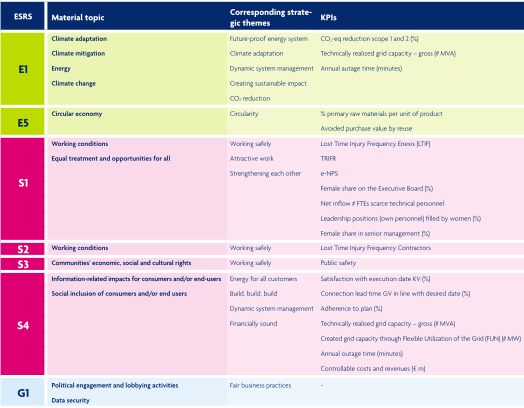
Not all KPIs presented on our ‘Objectives and achievements’ chart are included in the Sustainability Statement. This is partly because our strategy requires us to monitor progress using a broader set of KPIs than those needed to track impacts, risks, and opportunities. On the other hand, not all strategically important themes are considered material for the purposes of the Sustainability Statement. One example is heat: although it is of significant strategic importance, it is still limited in scale and therefore not included as a material topic in the Sustainability Statement.
The resilience of our strategy and business model
The resilience of our strategy and business model is underpinned by our essential role in the energy system and by the regulated market structure in which we operate. By law, Enexis shares must be held by public authorities, and Enexis has a monopoly within its designated service area. The Authority for Consumers and Markets (ACM) supervises Enexis and annually sets the maximum tariffs that may be charged to customers.
The implementation of our strategy and the achievement of our objectives depend in part on third parties, such as suppliers and contractors, as well as on societal factors, including energy consumption. Even in the event of lower-than-expected supply or demand, Enexis is able to continue its operations and generate income from its existing assets. These assets are critical to the infrastructure in the Netherlands and cannot easily be provided by other parties.(ESRS 2 SBM-3 par. 48f) At present, Enexis has not carried out a quantitative analysis of the resilience of its strategy and business model. (ESRS E1 icm ESRS 2 SBM-3 par. 19b en AR 7a)