

Enterprise risk management (ERM)
In 2025, the revised Corporate Governance Code was published, which includes the Statement on Risk Management (VOR). The VOR ultimately requires the board to provide a statement on the design, existence, and functioning of internal risk management and control systems for financial reporting, sustainability reporting, and operational and compliance risks. The areas in which Enexis deviates from the Corporate Governance Code in 2025 are explained in the Corporate Governance section.
Enexis uses the COSO ERM model and the Three Lines Model – global standards in the field of risk management – as the basis for its internal risk management and control system. In 2025, we conducted an extensive analysis of our internal risk management and control system to identify areas for improvement and strengthen it, and to determine what will ultimately contribute to a substantiated statement.
This has led us to further structure and standardise our internal risk management and control system in 2026. This will enable us to properly monitor and assess the design, existence, and functioning of our system with respect to sustainability reporting, compliance, and operational risks, as well as its use for financial reporting.
INTERNAL RISK MANAGEMENT AND CONTROL SYSTEM
Risk management enables Enexis to identify and manage risks that could affect the achievement of our objectives in a timely manner. Our approach is fully integrated into the planning and control cycle and into daily business processes. We promote risk awareness within the organisation and encourage employees to manage risks proactively and consciously.
Risk management not only helps us limit risks but also create and maintain value, improve performance, and ensure Enexis complies with laws and regulations. We use risk assessments to identify and analyse risks at all levels within the organisation, after which we implement appropriate control measures. Management is primarily responsible for risk control, supported by business controllers, Internal Audit & Risk (IA&R), and other staff functions. IA&R's group risk managers coordinate and facilitate the risk management process.
We have divided our risk management processes into TOP and operational risk management. The results of the TOP and operational risk analysis are reported to and discussed by the Executive Board and the Audit Committee or Supervisory Board.
TOP RISK MANAGEMENT
TOP risk management focuses on the most important risks that could threaten Enexis’ strategic objectives or continuity. These risks are identified, analysed, and assessed annually. Measures are determined for each TOP risk, and progress is reported periodically to the Executive Board.
Interconnected or related risks are clustered at the group level. Enexis has currently identified 10 clustered TOP risks. Risks positioned in the red area of the risk matrix fall outside Enexis’ risk appetite. To mitigate these risks, measures are in place to reduce them to at least the orange area. For risks in the orange area, the management determines whether additional measures are necessary.
OPERATIONAL RISK MANAGEMENT
Operational risk management focuses on the timely identification and control of risks that could disrupt day-to-day operations. This also includes risks identified in periodic compliance, privacy, security, and data management analyses. We strive to mitigate risks that exceed Enexis’ risk appetite through key controls. We record these key controls in our internal control framework (ICF). The most important risks and control measures are evaluated through periodic analyses and Control Self-Assessments (CSA). Divisional management evaluates the results of the CSA and, if necessary, adds them to the internal letter of representation (LOR), in which the most important shortcomings are reported.
In addition to the hard controls in the ICF, we also pay attention to soft controls. These focus on integrity, engagement, and collaboration. Our internal integrity committee monitors integrity, conducts periodic fraud risk analyses, and discusses fraud risk controls.

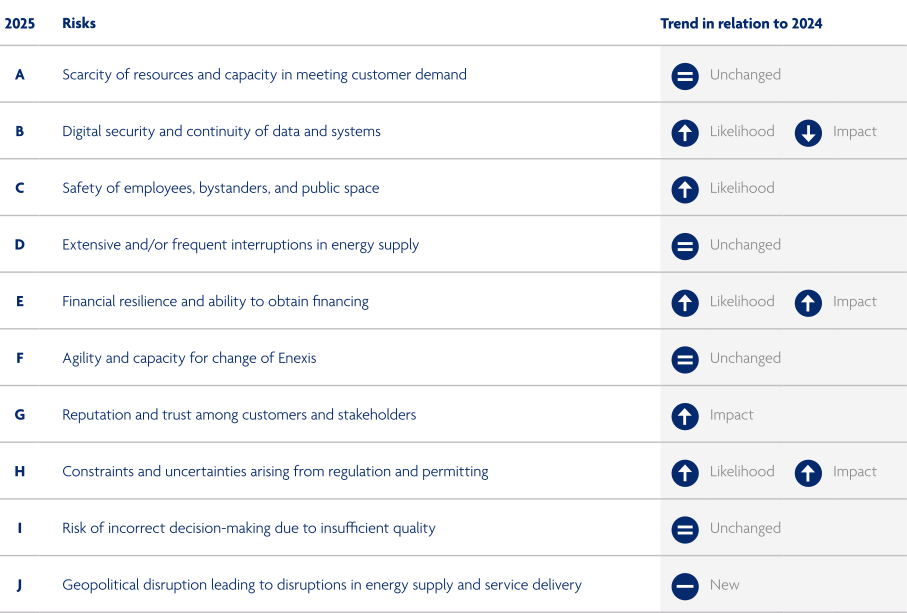
TOP RISKS
The TOP risks are described below. Specific risks relating to financial instruments are described in the notes to the financial statements.
|
Risk cluster |
Description and developments |
Key mitigating measures |
|---|---|---|
|
A. Scarcity of resources and capacity in meeting customer demand |
The energy transition and growing customer demand are leading to a structural shortage of staff, materials, and grid capacity. This results in delays in meeting customer requirements, higher costs, customer dissatisfaction, and risks to quality and safety. The labour market for technical staff is tight, the electricity grid is becoming increasingly congested, and the security of supply of materials is under pressure due to geopolitical and market factors. Despite a wide range of measures, the risk remains high, partly due to demographic developments, complex permitting processes, and limited predictability of material demand. This scarcity is expected to persist or even increase in the coming years. |
|
|
Risk in 2025 compared with 2024: |
||
|
Unchanged |
||
|
B. Digital security and continuity of data and systems |
Increasing digitalisation, growing dependence on cloud and IT systems, and the emergence of new technologies (such as quantum computing and generative AI) significantly increase the risk of unauthorised data use, cyberattacks, and large-scale system outages. Incidents may result in data breaches, disruption of business processes, reputational damage, financial losses, and non-compliance with laws and regulations. This threat is amplified by geopolitical tensions, the complexity of the IT landscape, and the limited maturity of certain processes. New legislation and technological developments require continuous adaptation of security measures. The risk remains high and is evolving rapidly, driven in particular by the fast adoption of AI and the anticipated breakthrough of quantum technologies. |
|
|
Risk in 2025 compared with 2024: |
||
|
Likelihood |

|
|
|
Impact |

|
|
|
C. Safety of employees, bystanders, and public spaces |
Working on electricity and gas infrastructure and in public spaces entails risks of accidents and health damage for employees and bystanders. Causes include incorrect risk assessments, unsafe situations, failing materials, aggression from the surrounding environment, and more complex working conditions than in the past. Incidents may result in serious injuries, long-term health effects, reputational damage, and financial consequences. Despite ongoing efforts, the risk is increasing due to the growing complexity of work, stricter legislation, and changing external conditions such as climate change and broader societal developments. |
|
|
Risk in 2025 compared with 2024: |
||
|
Likelihood |
|
|
|
D. Large-scale and/or frequent interruptions to the energy supply |
The risk of large-scale and/or frequent interruptions to the energy supply is increasing due to natural disasters, climate change, ageing networks, increased loads, and external threats such as deliberate damage or gas shortages. Such interruptions may result in prolonged power and gas outages, operational disruptions, legal consequences, and reputational damage. |
|
|
Risk in 2025 compared with 2024: |
||
|
Unchanged |
||
|
E. Financial resilience and ability to obtain financing of Enexis |
Enexis’ financial position is under pressure due to fluctuations in interest rates and commodity prices, rising investment levels, and a lag in the adjustment of regulatory remuneration. As a result, the need for equity increases, and attracting financing becomes more challenging. A deterioration in the credit profile could lead to higher interest costs, reduced access to funding, and diminished confidence among shareholders and lenders. Over time, this could jeopardise the continuity of investments and the execution of the strategy. Due to Enexis’ larger scale, declining financial buffers, and external economic developments, this risk has increased relative to the previous year. |
|
|
Risk in 2025 compared with 2024: |
||
|
Likelihood |
|
|
|
Impact |
|
|
|
F. Agility and capacity for change of Enexis |
The energy transition, changing legislation and regulations, and increasing market complexity require an organisation that can respond quickly and effectively to change. Enexis faces the risk that customer processes, employees, value chains, and overall change capacity may not be sufficiently agile to respond in a timely and effective manner, partly due to the organisation's rapid growth. This could result in delays in achieving strategic objectives, declining customer satisfaction, inefficiencies, increased workload, and missed opportunities in the energy transition. Despite various initiatives, the risk remains high due to the scale and pace of change, limited capacity, and the need for collaboration both within and outside the organisation. |
|
|
Risk in 2025 compared with 2024: |
||
|
Unchanged |
||
|
G. Reputation and trust among customers and stakeholders |
Due to energy system scarcity and uncertainty in investment planning, customer and stakeholder expectations cannot always be met. Insufficient transparency and delays or shortcomings in responding to complaints or incidents increase the risk of negative perceptions, complaints, and reputational damage. Incidents, delays, or unclear communication may lead to dissatisfaction, claims, and a loss of trust in the organisation. The potential impact of reputational damage has increased due to growing bottlenecks in the energy transition, waiting lists, limited customer options, and political and societal pressures amplified by social media. Fast and open communication is therefore increasingly important for maintaining trust. |
|
|
Risk in 2025 compared with 2024: |
||
|
Impact |
|
|
|
H. Constraints and uncertainties arising from regulation and permitting |
The energy transition requires rapid expansion of the electricity grid, but spatial constraints, complex and lengthy permitting procedures, changing legislation and regulations, and nitrogen-related restrictions are causing delays. In addition, legalisation is increasing: customers and stakeholders are increasingly resorting to legal proceedings when faced with delays or a lack of clarity. Political instability and policy unpredictability further complicate timely anticipation. As a result, projects may be delayed or cancelled, costs may rise, and the risk of dissatisfaction and reputational damage increases. While the urgency is high, the required acceleration is constrained by external factors and internal coordination. Consequently, this risk has increased compared with 2024. |
|
|
Risk in 2025 compared with 2024: |
||
|
Likelihood |
|
|
|
Impact |
|
|
|
I. Risk of incorrect decision-making due to insufficient data quality |
Enexis is increasingly dependent on data for operational decision-making and process management. Insufficient accuracy, completeness, or timely availability of data may lead to incorrect decisions, disruptions in core processes, and unreliable reporting. As the use of predictive models and artificial intelligence continues to grow, the importance of high data quality becomes ever more critical. Data quality issues heighten the risk of errors, increased costs, and loss of trust. The need to rely on accurate and timely data is increasing, particularly as the network becomes more complex and must respond more rapidly to developments. |
|
|
Risk in 2025 compared with 2024: |
||
|
Unchanged |
||
|
J. Geopolitical disruption leading to disruption of energy supply and service delivery |
Increasing geopolitical tensions, cyber threats, supply chain disruptions, and international conflicts expose Enexis to the risk of interruptions to energy supply and services for customers and society. This may result in reduced reliability, higher costs, limited access to energy, and damage to infrastructure. The energy transition and growing dependence on international markets further increase this vulnerability. This risk is new as an integrated theme, although individual components, such as cyber and procurement risks, had already been identified. The likelihood of disruption is real, and the potential impact is very significant, making resilience increasingly important. |
|
|
Risk in 2025 compared with 2024: |
||
|
New in 2025 |