
Ensuring a reliable energy supply and realising the energy transition are essential social tasks that are funded by the public purse. That is why we attach great importance to a good governance structure and are transparent about how our company is managed and supervised.
Enexis Holding N.V. is a public company under Dutch law. Our company is subject to what is known as the two-tier board structure. As our shares are not listed, we are not required to adhere to the Corporate Governance Code. Nevertheless, we do so according to the principle of ‘comply or explain’. This underlines our commitment to socially responsible business practices. Our articles of association, regulations, and other corporate governance documentation can be found on our corporate website.
Executive Board
The Executive Board (EB) is responsible for the management of Enexis. The EB defines the strategy, ensures the preconditions for its implementation, and sets the operational and financial objectives. The EB also ensures compliance with all relevant laws and regulations, risk management, and the company's financing.
The EB operates within the provisions of the articles of association and under the supervision of the Supervisory Board (SB). Together, they are responsible for the corporate governance structure and compliance with the Corporate Governance Code. The EB reports to the General Meeting of Shareholders (AGM) every year.
The members of the EB are appointed for an indefinite period. They are remunerated in accordance with the remuneration policy approved by the AGM. The SB determines the remuneration of each member of the EB. The total remuneration of the EB is disclosed in the financial statements.
The EB and SB recognise the importance of gender balance within the EB. By 2030, at least 40% of the EB should be women and 40% men. Ultimo 2025, the EB consists of three men and one woman. In recruiting a new Chief Transition Officer, we are taking this aim of achieving a balanced composition of the Executive Board into account.
On 1 June 2025, Mariëlle Vogt was succeeded as a member of the EB/CFO by Marjanne van Ittersum. CTO Jeroen Sanders left Enexis on 1 March 2026. The procedure for his succession is ongoing.
Composition of the Executive Board
The table below lists the main areas of responsibility for each member of the EB. (ESRS 2 GOV-1 paras. 19, 20 and 21)
|
Rutger van der Leeuw CEO (Male) |
Marjanne van Ittersum CFO (Female) |
Han Slootweg COO (Male) |
Jeroen Sanders (Male) |
|
|
General management |
V |
V |
V |
V |
|
Financial economic |
V |
V |
||
|
Social policy, organizational development and participation |
V |
V |
V |
V |
|
Technology and regulation in the energy (distribution) sector |
V |
V |
V |
|
|
Product growth/Energy system of the future |
V |
V |
||
|
Commercial/customers |
V |
V |
V |
|
|
Politics, society and sustainability |
V |
V |
V |
V |
|
Information policy, digitalization and cyber security |
V |
V |
||
|
Governance |
V |
V |
||
|
Safety and risk management |
V |
V |
V |
V |
Based on the above division of areas of responsibility, we have divided the portfolios as follows:
|
Rutger van der Leeuw CEO |
Marjanne van Ittersum CFO |
Han Slootweg COO |
Jeroen Sanders CTO |
|
Strategy |
Finance & Control |
Production North |
Assetmanagement |
|
Regulation |
ICT, Data & Digitalization |
Production South |
Market facilitation |
|
Communication & Public Affairs |
Purchase |
High volume consumers |
Energy system & Environment |
|
Human Resources |
Treasury |
Consumers |
Innovation & Development |
|
HSEQ |
Corporate & Legal Affairs |
High Voltage/Low Voltage-Stations |
Enpuls/ Heat strategy |
|
Internal Audit & Risk |
Grid Performance Management |
||
|
CISO |
Supply Chain |
||
|
Operations support |
Information about the expertise and experience of the members of the Executive Board is included in the biographies of the Executive Board. (ESRS 2 GOV-1 par. 21)
Supervisory Board
The Supervisory Board has three tasks: supervising the policies of the EB, providing solicited and unsolicited advice, and acting as the employer of the EB.
The SB has two permanent committees: the Audit Committee and the HR Committee. These committees prepare the SB's decision-making in their areas of responsibility and advise the SB on these matters.
The members of the SB receive remuneration for their work. This remuneration is determined by the AGM and falls within the framework of the Standards for Remuneration Act (Wet Normering Topinkomens, WNT). The total remuneration of the SB is disclosed in the financial statements.
The SB recognises the importance of gender balance within the SB. The SB consists of 40% men (two men) and 60% women (three women). This is in line with the target of at least 40% male and at least 40% female members. The current composition is available on our corporate website.
The members of the SB and the retirement schedule:
|
Member Supervisory Board (function) |
Year of first appointment |
Year of reappointment |
Retiring |
|
Mr. Jos Nijhuis (chair) |
2022 |
2026 (eligible) |
|
|
Mrs. Anita Arts (member) |
2019 |
2023 |
2027 (not eligible) |
|
Mr. Joost van Dijk (vice chair/member) |
2016 |
2024 |
2026 (not eligible) |
|
Mrs. Wilma Mansveld (member) |
2023 |
2028 (eligible) |
|
|
Mrs. Els de Groot (member) |
2024 |
2028 (eligible) |
The table below shows the main areas of responsibility for each SB member. (ESRS 2 GOV-1 paras. 19, 20a and 21)
|
Jos Nijhuis (Male) |
Joost van Dijk (Male) |
Anita Arts (Female) |
Wilma Mansveld (Female) |
Els de Groot (Female) |
|
|
General management |
V |
V |
V |
V |
V |
|
Financial economic |
V |
V |
V |
||
|
Social policy, organizational development and participation |
V |
V |
|||
|
Technology and regulations in the energy (distribution) sector |
V |
V |
|||
|
Production growth/Energy system of the future |
V |
V |
V |
||
|
Commercial/customers |
V |
V |
|||
|
Politics, society and sustainability |
V |
V |
V |
V |
V |
|
Information policy, digitalization and cyber security |
V |
V |
V |
V |
|
|
Governance |
V |
V |
V |
V |
|
|
Safety and risk management |
V |
V |
V |
V |
V |
|
Committees |
Chair Supervisory Board |
Vice-Chair Supervisory Board |
Chair HR Committee |
Member Audit Committee |
Chair Audit Committee |
|
Strenghened right of appointment |
n/a |
n/a |
Appointed on the recommendation of the Works Council |
Appointed on the recommendation of the Shareholders Committee |
n/a |
Our corporate website (Supervisory Board) provides the biographies of the SB members, including information about their expertise and experience. (ESRS 2 GOV-1 par. 21)
Roles and responsibilities of the EB and SB in the field of sustainability
The EB and SB have specific responsibilities with regard to sustainability policy and reporting. As a collegial body, the entire EB is responsible for overseeing the process of managing material impacts, risks, and opportunities related to ESG issues. Among other things, the EB takes joint decisions on sustainability aspects of strategy, policy, and targets.
The double materiality analysis and the sustainability report are prepared under the guidance of the External Reporting department. These are then submitted to the EB for review and approval. Formulating the (sustainability) strategy is the responsibility of the strategy director. Approval of this strategy and the associated targets is the responsibility of the EB.
The EB monitors the management of sustainability topics. It discusses progress against the business plan on a quarterly basis. From the 2025 financial year onwards, sustainability topics are also included in this report. Policy monitoring also includes achieving sustainability targets, implementing the sustainability strategy, and managing risks associated with business activities. The SB also monitors internal systems for risk management and control, and non-financial reporting. Progress on sustainability topics is monitored through internal audits. (ESRS 2 GOV-1 paras. 19, 20b and 22)
The EB periodically informs the SB of the views and interests of relevant stakeholders on sustainability issues. (ESRS 2 SBM-2 par. 45d)
Documentation such as the double materiality analysis, sustainability strategy, and sustainability reporting is submitted to the SB for discussion during the year. The SB then discusses any comments and observations with the EB.
Expertise of the EB and SB in the field of sustainability
Members of the EB must have specific expertise and skills in the field of material sustainability topics. These requirements are explained in detail in the profile descriptions.
For the composition of the SB, a profile description includes the required relevant experience in both generic and specific focus areas, including ‘Politics, society, and sustainability’ and ‘Safety and risk management’. Given the nature of the business, no specific experience with specific geographic locations is required. The focus areas fall within the knowledge and experience of one or more SB members.
Both EB and SB members maintain and update their knowledge through continuing education. If specific expertise is required that the members do not possess, external experts are consulted. (ESRS 2 GOV-1 paras. 19, 20c and 23)
Information provision and handling of sustainability topics
In 2024, Enexis conducted its first double materiality analysis in accordance with the requirements of the European Sustainability Reporting Standards (ESRS). Both the EB and the SB were involved in this process and were periodically informed through written updates on progress, milestones, and decisions. In addition to formal meetings, the EB was regularly briefed by the chair of the CSRD Steering Group, who has a direct reporting line to the CFO. The External Reporting department worked closely with other departments to identify the material impacts, risks, and opportunities. In addition, the EB and SB were informed through internal reports about due diligence activities and the results and effectiveness of policies, measures, metrics, and targets with regard to material impacts, risks, and opportunities. ESRS 2 GOV-2 paras. 24 and 26a
Parallel to the introduction of the Corporate Sustainability Reporting Directive (CSRD), the ESG strategy was developed and approved by the EB and SB. The ESG strategy links the material ESRS topics to the strategy and objectives of Enexis. When deciding on the strategy, significant transactions, and measures, the EB considers potential dilemmas regarding the impacts, risks, and opportunities. (ESRS 2 GOV-2 paras. 24 and 26b)
In addition, the Supervisory Board closely monitored the implementation of the CSRD, and sustainability topics were discussed on four occasions. ESRS 2 GOV-2 paras. 24 and 26c
General meeting of shareholders
The General Meeting of Shareholders is the highest decision-making body within Enexis. The AGM approves the annual report, discharges the EB and the SB, approves the financial statements, and determines the profit appropriation. The AGM also endorses the company's strategy and appoints the members of the SB.
Certain powers of the AGM are delegated to the Shareholders’ Committee (SHC). This committee has seven members and promotes efficient and effective decision-making within the AGM. The members do not receive any remuneration for their work.
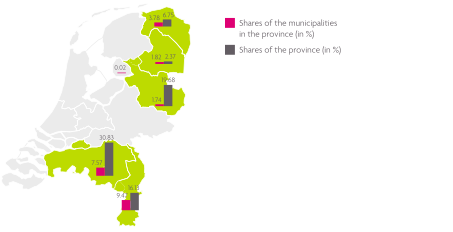
The 91 shareholders of Enexis Holding N.V. are predominantly provinces and municipalities in the service area of Enexis Netbeheer B.V.
Internal audit function
The Internal Audit & Risk (IA&R) department performs the internal audit function at Enexis. IA&R provides insight, advice, and additional assurance to the EB and management regarding operational control, effectiveness, efficiency, and compliance (with laws and regulations) of the business operations.
The department reports to the CFO and provides quarterly reports to the full EB on both internal audit and risk management activities. In addition, IA&R has direct access to the CEO, the chair of the Audit Committee, and the external auditor. IA&R also attends the meetings of the SB Audit Committee. The Audit Committee oversees the internal audit function and advises the SB on its role and functioning. The quality of the internal audit function is assured by an external audit every five years.
IA&R draws up an annual risk-based audit plan, involving senior management, the EB, the Audit Committee, and the external auditor. The EB adopts the audit plan, and the SB approves it after consulting with the Audit Committee. During its meetings, the Audit Committee discusses the plan's progress, key findings, and follow-up on recommendations. The external auditor also receives this information.
External auditor
The external auditor is appointed by the AGM. EY has been appointed as external auditor as of 2021 for an initial term of four years, with three extension options of two years each. The first extension option was exercised in 2024, and EY was reappointed for the 2025 and 2026 financial years.
In connection with the mandatory rotation of the external auditor, Mr S. Mom of EY Accountants B.V. will assume responsibility for the statutory audit as from the 2026 financial year. He will succeed Mr P. Dirks, who has served as external auditor since the 2021 financial year.
The Audit Committee oversees the relationship with the external auditor. EY attends all Audit Committee meetings and participates in the AGM at which the financial statements are adopted, and is present at Extraordinary General Meetings.
More detailed information on governance is available in the sustainability statement.
Compliance with the Corporate Governance Code
We deviate from the Corporate Governance Code in the following provisions:
Provision 1.4.3: Statement by the management
Provision 1.4.3. IV: Enexis will use 2026 to further structure and standardise its internal risk management and control system for operational and compliance risks in order to maintain a more efficient overview and make adjustments where necessary. The effectiveness of these systems will therefore only be assessed by management in 2026.
These improvements will also contribute to a well-founded substantiation of the effectiveness of these systems with regard to operational and compliance risks for 2026. We therefore deviate from these specific provisions of the Dutch Corporate Governance Code in the 2025 Annual Report.
Provision 4.2.2: policy regarding bilateral contacts with shareholders
Enexis does not have a formal policy for bilateral contacts with shareholders, as stipulated in the code. However, we do have a covenant in place with detailed agreements between the EB, SB, and the Shareholders' Committee about the fulfilment of tasks, as laid down in the articles of association.
Various provisions in the code do not apply to Enexis because our shares are held by Dutch government bodies and are not listed on the stock exchange.
Specifically, these are:
Provision 2.1.3: Executive Committee
Provisions 2.8.1-2.8.3: takeover bid
Provision 3.1.3: remuneration of the Executive Committee
Provisions 3.3.2-3.3.3: remuneration of SB members in shares and
share ownership of SB members
Provisions 4.2.3-4.2.6: information and protective measures
Provisions 4.3.1-4.3.8: casting votes
Provisions 4.5.1-4.5.7: issuing depositary receipts for shares
Provisions 5.1.1-5.1.4: one-tier governance structure